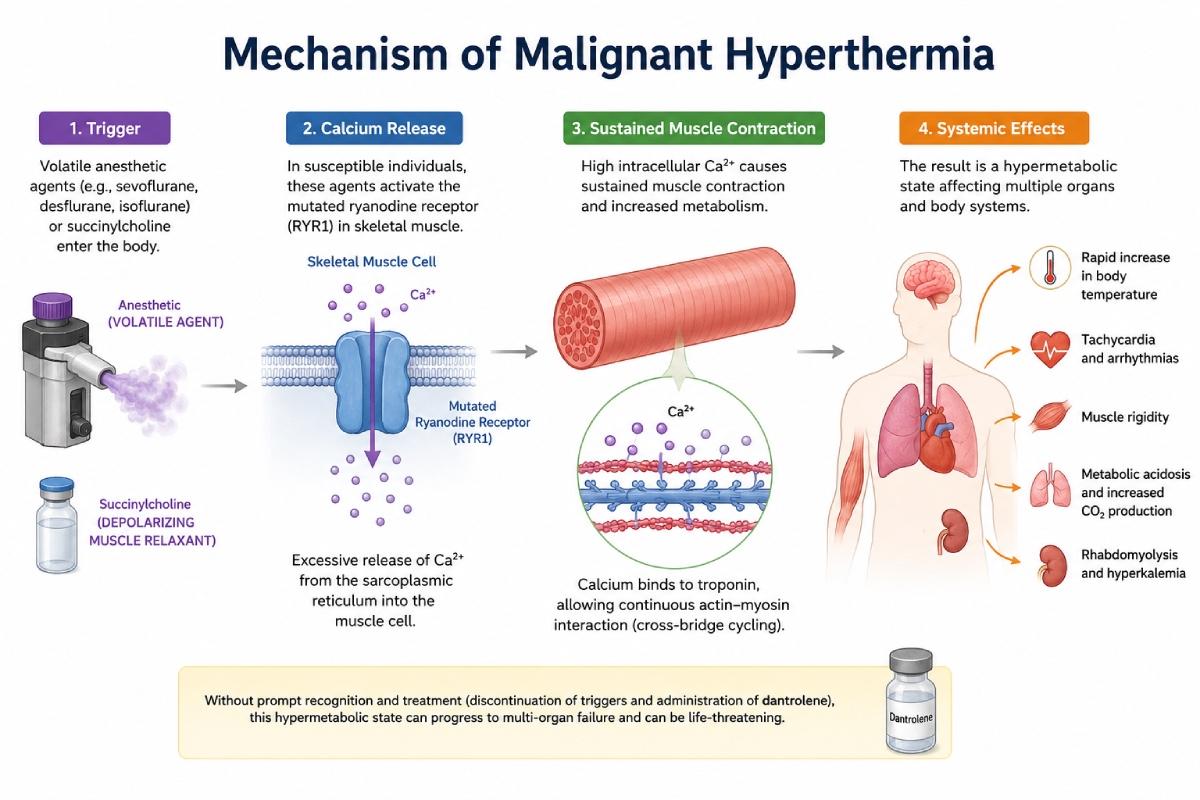
Malignant hyperthermia (MH) is a pharmacogenetic disorder in which exposure to volatile anesthetics, such as halothane, isoflurane, sevoflurane, and desflurane, or the depolarizing muscle relaxant succinylcholine, precipitates a hypermetabolic crisis in skeletal muscle (1). Despite its name, malignant hyperthermia is not a primary disorder of thermoregulation. Rather, hyperthermia is a consequence of the uncontrolled excitation-contraction coupling within skeletal muscle that occurs. Malignant hyperthermia is a rare but extremely dangerous complication of anesthesia, with research across decades having uncovered its underlying mechanism, leading to the establishment of safeguards and response protocols.
The Ryanodine Receptor at the Center
Dysregulation of the type 1 ryanodine receptor (RyR1), the calcium release channel of the sarcoplasmic reticulum (SR), is at the core of malignant hyperthermia (1,2). Under normal conditions, depolarization of the T-tubular membrane is sensed by the dihydropyridine receptor (DHPR), which mechanically or allosterically activates RyR1, triggering a brief, tightly regulated release of calcium from the SR into the myoplasm to initiate muscle contraction (2,4). In MH-susceptible individuals, mutations in RyR1—of which more than 400 have been identified, with at least 34 confirmed as causal—lower the threshold at which the channel opens and increase its sensitivity to pharmacologic and physiologic activators, including volatile anesthetics, caffeine, and elevated myoplasmic or luminal calcium itself (1,2). A smaller proportion of cases (less than one percent) arise from variants in CACNA1S, which encodes the pore-forming α1 subunit of the DHPR, or, rarely, from mutations in STAC3 (1,2).
Triggering the Hypermetabolic Crisis
When a susceptible individual is exposed to a triggering agent, RyR1 channels open excessively and fail to close normally, producing a sustained, unregulated efflux of calcium from the SR (1,2,4). The SR calcium-ATPase (SERCA) attempts to resequester this calcium, but the process is energetically futile: ATP is consumed at an accelerating rate to counter continuous leak, generating heat and depleting cellular energy reserves (1,4). The persistently elevated myoplasmic calcium concentration simultaneously activates the contractile apparatus, producing sustained muscle contracture and, when severe, the classic finding of masseter or generalized rigidity, and it drives glycogenolysis and oxidative metabolism, resulting in markedly increased oxygen consumption and carbon dioxide production (1,4). This hypermetabolic state manifests clinically as tachycardia, tachypnea, and a rise in end-tidal carbon dioxide despite increased minute ventilation, often the earliest reliable warning sign (1).
Systemic Consequences
As ATP stores fail, SR integrity is compromised, releasing potassium, creatine kinase, and myoglobin into the circulation and leading to hyperkalemia and rhabdomyolysis (1,3). Uncoupled ATP hydrolysis is the mechanism behind the elevated temperatures seen in malignant hyperthermia, with core temperature rising sometimes at a rate of 1–2°C every five minutes. In addition, respiratory and metabolic acidosis develops from carbon dioxide accumulation and lactate production (1,3). This cascade progresses to disseminated intravascular coagulation, cardiac arrhythmia, and multiorgan failure (1,3).
Modulators and Treatment
Additional modulators influence phenotypic expression. Accessory SR and triadic proteins can affect the sensitivity of RyR1, and post-translational modifications such as S-palmitoylation, phosphorylation, and nitrosylation of RyR1 can further alter channel behavior (1). Dantrolene, the only specific pharmacologic antagonist, acts by inhibiting RyR1-mediated calcium release, directly interrupting the pathogenic cycle and restoring myoplasmic calcium homeostasis (1,4). It is the only effective treatment option for patients experiencing malignant hyperthermia.
In summary: malignant hyperthermia occurs when volatile anesthesia triggers genetically sensitized RyR1 release channels into pathological calcium release, producing the downstream effects of a systemic hypermetabolic emergency. Fortunately, research has elucidated the mechanism of malignant hyperthermia, allowing dantrolene to be identified as a treatment and leading to effective screening protocols according to patient risk.