End-expiratory lung volume (EELV) — the volume of air remaining in the lungs at the end of a normal, passive exhalation — is a fundamental parameter of respiratory physiology. It reflects the resting equilibrium point of the respiratory system, where elastic recoil of the lungs inward is balanced by the chest wall's tendency to spring outward. Measuring EELV provides critical information about lung mechanics, disease state, and response to treatment in both clinical and research settings.
Clinical Importance of EELV
EELV is functionally equivalent to functional residual capacity (FRC) during normal, unloaded breathing. Conditions that reduce EELV — including obesity, supine positioning, general anesthesia, abdominal distension, and respiratory disease — predispose patients to alveolar collapse (atelectasis), intrapulmonary shunting, and hypoxemia. Conversely, conditions that elevate EELV, such as COPD with dynamic hyperinflation, create problems with air trapping and impaired exhalation.
Clinical applications of EELV measurement include:
- Monitoring COPD patients for disease progression and response to bronchodilator therapy
- Assessing ventilator settings in mechanically ventilated ICU patients (PEEP titration, lung recruitment)
- Evaluating acute lung injury patients for recruitability
- Perioperative monitoring of respiratory function in high-risk surgical patients
Methods of Measurement
1. Spirometry
Conventional spirometry uses a spirometer to record exhaled air volume during breathing maneuvers. While spirometry precisely measures expiratory flow rates, tidal volume, and vital capacity, it cannot directly measure FRC or EELV because these involve gas trapped in the lungs at end-expiration — not exhaled to the device. Spirometry must be paired with other techniques (dilution or plethysmographic methods) for EELV determination.
2. Body Plethysmography
Whole-body plethysmography (the "body box") is the reference standard for FRC measurement in pulmonary function laboratories. The patient sits inside a sealed, rigid chamber. During breathing efforts against a closed shutter, changes in mouth pressure and box pressure are measured. Using Boyle's law (at constant temperature, pressure and volume are inversely related), lung gas volume at end-expiration can be calculated with high accuracy.
Body plethysmography is particularly important in patients with obstructive lung disease, where gas trapping behind closed airways (communicating poorly with the mouth) means dilution techniques underestimate true EELV. Plethysmography measures all intrathoracic gas regardless of connectivity.
3. Nitrogen Washout Technique
The multiple-breath nitrogen washout method measures EELV by having the patient breathe 100% oxygen while gas analyzers track the progressive washout of nitrogen from the lungs. Since nitrogen makes up approximately 78% of room air at a known concentration, the total volume of nitrogen washed out — divided by the initial fractional nitrogen concentration — yields the volume of gas the nitrogen originally occupied (i.e., FRC).
This technique is reliable in patients with healthy, well-communicating airways. It underestimates EELV in patients with poorly communicating airspaces (advanced emphysema, bullous disease).
4. Helium Dilution Method
The helium dilution technique uses a closed-circuit breathing system containing a known volume of helium in air at a known concentration. As the patient breathes the helium mixture, helium distributes throughout the lung gas volume. The new, lower helium equilibrium concentration after breathing is measured, and the dilution factor is used to calculate the additional volume (FRC) that the helium was diluted into. Like nitrogen washout, this method may underestimate EELV in severe obstructive disease.
5. Radiological Techniques
Imaging modalities provide structural rather than purely functional assessment of lung volumes:
- Plain chest radiography: Can provide rough visual estimates of lung inflation and detect gross abnormalities but is not used for volumetric EELV measurement
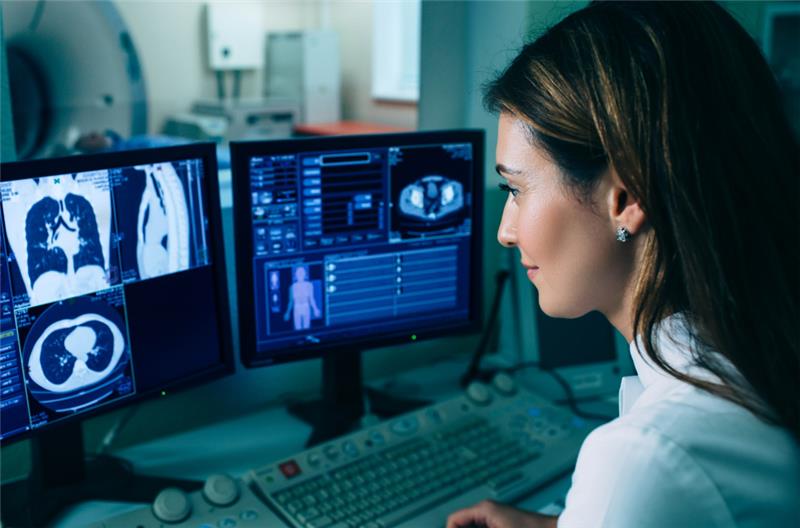
- Computed tomography (CT): CT scanning at end-expiration generates 3D reconstructions from which lung volumes can be calculated with high precision — the most accurate imaging-based approach. CT also provides detailed information on regional distribution of aeration and identifies atelectasis
- Magnetic resonance imaging (MRI): Offers the advantage of no ionizing radiation and is being developed for quantitative lung volume assessment, though current limitations in MRI lung imaging still constrain routine use
6. Electrical Impedance Tomography (EIT)
EIT is a non-invasive, bedside technique in which electrodes placed around the chest wall generate electrical impedance maps that track ventilation distribution and regional lung aeration in real time. Because impedance changes correlate with volume changes, EIT can provide continuous, breath-by-breath monitoring of EELV changes during mechanical ventilation — making it uniquely valuable in the ICU for PEEP titration and lung recruitment assessment. EIT does not require gas sampling, radiation, or patient cooperation.
Choosing the Right Method
Each technique has specific strengths and limitations, making method selection context-dependent. The pulmonary function laboratory typically uses plethysmography (most accurate for obstructed patients) combined with spirometry. The ICU is increasingly adopting EIT for continuous non-invasive monitoring. Research settings may use CT for high-precision volumetric analysis. Understanding which tool fits which clinical question is the foundation of intelligent respiratory monitoring.